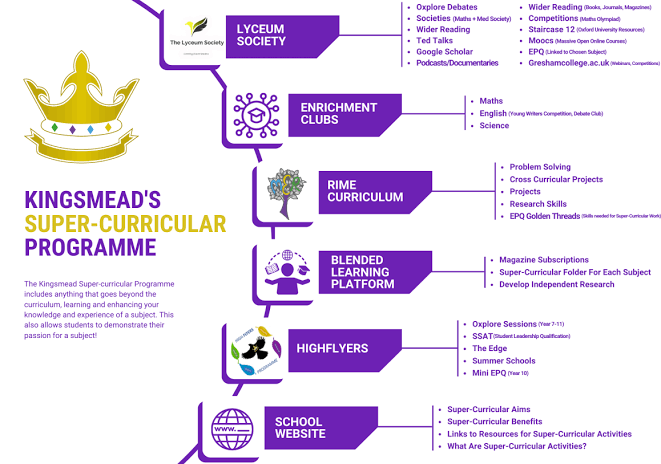
Maths supercurriculars are activities that extend mathematical learning beyond the material required for school or college. They stay closely connected to the subject, so they may involve solving unfamiliar problems, reading about mathematical ideas, attending lectures, exploring proofs, entering competitions, using code to investigate patterns, or carrying out a small project. The purpose is not to collect certificates. It is to think mathematically in situations where the method is not already shown, the answer may take several attempts, and curiosity determines what you explore next.
This makes maths supercurriculars different from general extracurricular activities. Sport, music, volunteering, and clubs can develop valuable personal skills, but a supercurricular should deepen your understanding of mathematics itself. A useful activity normally leaves you with more than completion: a difficult problem you learned to approach differently, a theorem you wanted to understand, a model you tested, or a question that led to another source. That progression from exposure to investigation is what makes the experience academically meaningful for students considering mathematics or other quantitative degrees.
Best Maths Supercurricular Ideas for Year 12 Students
Year 12 students usually benefit most from activities that stretch them without demanding university-level knowledge from the start. Problem-solving is a strong foundation. NRICH provides secondary and post-16 tasks designed to develop mathematical reasoning, while UKMT challenges expose students to problems requiring more than routine classroom methods. The UKMT Senior Mathematical Challenge is aimed at students in Year 13 or below, and its problems are designed to make students think rather than simply apply memorised techniques. These resources can build persistence and confidence when approaching unfamiliar mathematical questions.
Other worthwhile options include mathematical reading, public lectures, coding investigations, statistics projects, and online courses. A student interested in number theory might explore divisibility or modular arithmetic and then test patterns with simple code. Someone interested in probability could compare theoretical results with simulations, while a student drawn to geometry might investigate how a result changes when one assumption is altered. The activity does not need to be prestigious. A modest project can become a strong supercurricular if the student asks a focused question and works through the mathematics carefully.
How to Choose the Right Maths Supercurriculars
Choose activities by matching your interest, current level, and available time. Accessible options include NRICH problems, mathematics books for sixth-form readers, recorded university talks, and structured online lessons. Students who already enjoy non-routine problems can move towards UKMT Olympiad-style material, proof-based topics, Project Euler, or independent investigations. The key question is whether the activity requires active mathematical thinking. Watching several lectures without solving or questioning anything may add less value than spending an hour working seriously on one difficult problem and comparing different solution methods.
It also helps to combine breadth with depth. Breadth lets you sample areas such as combinatorics, statistics, geometry, mathematical modelling, or cryptography. Depth begins when one experience leads to further work. A lecture on graph theory, for example, might lead you to learn Euler trails, solve several network problems, and write a short program to test routes. This creates a visible learning trail rather than a disconnected list of activities. For students with limited time, one sustained investigation and regular problem-solving can be more useful than several certificate-focused courses.
Turning Activities Into Real Mathematical Development
A supercurricular becomes more valuable when you can explain what happened during the learning process. Instead of recording only the title of a book or competition, note the mathematical idea that caught your attention, the part you found difficult, the method you tried, and the question that remained afterwards. If a probability problem initially led you to an incorrect intuition, for instance, working through a counterexample and explaining why your first assumption failed shows more mathematical development than simply saying that you enjoy probability.
A simple learning record can make this process consistent. After each substantial activity, write four short notes: what you explored, what you learned, what challenged you, and what you will investigate next. Over several months, these notes reveal patterns in your interests and make it easier to choose deeper projects. They also replace vague claims such as “this improved my problem-solving” with specific evidence, such as learning to test small cases before generalising, separating necessary from sufficient conditions, or recognising when a pattern needs a proof rather than more examples.
Maths Supercurriculars and University Applications in 2026
For applications beginning with 2026 entry, UCAS uses three personal-statement questions rather than one continuous piece of text, while retaining the overall 4,000-character limit. The third question asks what applicants have done outside formal education to prepare and why those experiences are useful, giving maths supercurriculars a natural place when they genuinely demonstrate preparation. UCAS guidance for mathematics and statistics also emphasises relevant skills and reflection. A stronger application therefore explains what an activity changed in your mathematical understanding instead of presenting a list of books, competitions, courses, or events.
Students considering Oxford or Cambridge should separate supercurricular learning from admissions-test preparation. For the 2026 admissions round, Oxford has replaced the MAT with the TMUA for Mathematics and several related courses, with Oxford applicants taking the October sitting. Cambridge Mathematics applicants for 2027 entry are also required to take the TMUA during the application process; STEP remains important later because it is used in almost all conditional offers for Mathematics and Mathematics with Physics. Problem-solving practice may support these assessments, but admissions-test preparation should not become the only form of wider mathematical exploration.
A Four-Week Maths Supercurricular Plan
A four-week cycle can turn an interesting topic into genuine independent study. In week one, choose a narrow area and learn enough background to understand its basic definitions and examples. In week two, solve several problems and mark the ones that required a new idea rather than routine calculation. In week three, take one question further by changing an assumption, testing a pattern with code, searching for a proof, or comparing two methods. In week four, write a short reflection explaining the mathematics, the difficulty you encountered, and the next question worth pursuing.
The output matters more than the number of hours spent. By the end of the cycle, you should ideally have a small collection of worked problems, annotated notes, a short piece of code, a diagram, a proof attempt, or a concise written explanation. You can then decide whether to deepen the same topic or begin another area. Repeating this process creates a personal mathematics portfolio without turning supercurricular study into a second school timetable, while helping you identify whether your interest lies in pure mathematics, statistics, computation, modelling, or another direction.
Conclusion
Good maths supercurriculars do not have to be expensive, exclusive, or impressive on paper. Their value comes from the quality of the mathematical thinking they produce. A student who solves difficult problems regularly, follows questions beyond the original task, and reflects on mistakes may gain more than someone who completes several prestigious activities without engaging deeply. Resources such as NRICH, UKMT material, books, lectures, coding projects, and independent investigations are starting points. The stronger outcome is the chain of reasoning and curiosity that develops after the starting resource has done its job.
The most practical approach is to choose one activity that suits your level, work on it consistently, and let your questions determine the next step. Keep evidence of what you attempted and learned, but do not treat the process as a box-ticking exercise for university applications. If an activity helps you become more comfortable with uncertainty, construct clearer arguments, notice patterns, test conjectures, or explain why a method works, it is serving its purpose. That mathematical development makes supercurricular work valuable even before any university application is written.
FAQs
What are maths supercurriculars?
They are maths-focused activities that extend learning beyond the school curriculum.
What are good maths supercurriculars for Year 12?
UKMT problems, NRICH activities, maths books, lectures, coding projects, and independent investigations are useful options.
Do maths supercurriculars help with university applications?
Yes. They can show subject interest, independent learning, and deeper mathematical thinking.
Does reading maths books count as a supercurricular?
Yes, especially when you reflect on the ideas and explore related problems afterwards.
Are maths competitions considered supercurriculars?
Yes. Competitions such as UKMT challenges can strengthen problem-solving and mathematical reasoning skills.
You May Also Read: Anglo Saxon Norse and Celtic