
The HE+ Programme is an academic enrichment and university-preparation initiative involving the University of Cambridge, its Colleges, and partner state schools and colleges. It is aimed particularly at students from under-represented backgrounds who have the academic potential to make competitive applications to highly selective universities. Rather than focusing only on Cambridge admission, the programme helps students understand higher education, explore subjects in greater depth, and become more familiar with the type of independent learning expected at university.
HE+ is especially relevant to students who want to go beyond their normal school curriculum. Participants can experience academic lectures, seminar-style learning, university guidance and independent research. Cambridge reports that the programme has been running for more than 13 years and has worked with around 30,000 students since it began. For students trying to understand whether HE+ is suitable for them, the most important points are eligibility, access through partner schools, the activities involved and how the experience can support preparation for higher education.
What Is the HE+ Programme?
HE+ is part of Cambridge’s wider work to improve access to higher education for students who may have experienced educational disadvantage or are from groups that are less likely to progress to university. Participating state schools and colleges work with Cambridge through regional partnerships. Students selected through these partner institutions receive opportunities to learn more about university, strengthen their subject knowledge and experience forms of academic study that may differ from everyday sixth-form lessons.
A useful way to understand HE+ is to think of it as preparation rather than admissions coaching. Students are encouraged to investigate subjects, question ideas, discuss academic material and undertake independent work. At the same time, they receive information that can make university choices and applications easier to understand. These experiences can be valuable for students considering Cambridge or other selective universities, but participation in HE+ does not guarantee an offer from any institution.
Who Is Eligible for HE+?
Students cannot simply submit an individual application to the HE+ Programme from any school. According to Cambridge’s current guidance, participants must attend an HE+ partner school and have the academic potential to make a competitive application to a highly selective university. The programme prioritises students who have experienced educational disadvantage and those belonging to groups that have lower rates of progression into higher education.
This means that a student interested in HE+ should first find out whether their school or college participates in the programme. A teacher, sixth-form team or careers adviser should be able to explain whether HE+ opportunities are available locally and how students are identified. Cambridge currently does not consider individual HE+ applications from students outside its partner schools, so checking participation through the school is more useful than searching for a general student application form.
What Do Students Do on the HE+ Programme?
HE+ runs across Year 12, from the autumn through to the summer term, and combines online and face-to-face activities. Students receive guidance about higher education as well as opportunities to experience more advanced academic learning. Current programme activities include lectures delivered by Cambridge PhD students and mock seminars involving current Cambridge students. These sessions expose participants to unfamiliar questions and encourage them to engage with ideas rather than simply learn material for an examination.
University preparation is another important part of the experience. Students receive information and guidance that can help them compare university options, understand applications and think about the transition from school to independent study. Many participants may also have the opportunity to make a funded visit to Cambridge. Seeing a university environment and meeting current students can give participants a more realistic understanding of university life before they make important decisions about where and what to study.
The HE+ Project and Independent Research
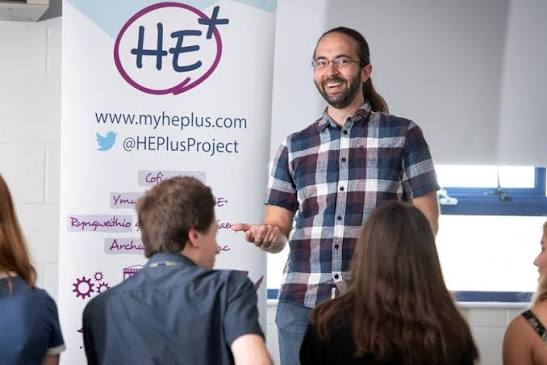
Independent research forms a distinctive part of HE+. Through the HE+ Project, students investigate an academic topic and develop their work into a research poster. Posters can be submitted to the National HE+ Project Competition, and participants receive written feedback from a Cambridge student. The purpose goes beyond producing a finished poster: researching a question requires students to decide what information is relevant, consider the quality of their sources and communicate an argument clearly.
These are useful habits for higher education because university learning places greater responsibility on students to investigate topics independently. A research project can introduce that way of working while students are still at school. It may also help them discover whether they genuinely enjoy exploring a particular subject beyond their existing syllabus. That insight can be valuable when choosing a university course, where sustained interest in the subject matters considerably more than simply selecting a prestigious institution.
HE+ and Learning Beyond the School Curriculum
One of the most valuable ideas behind HE+ is super-curricular learning. Unlike general extracurricular activities such as sport or volunteering, super-curricular activities deepen a student’s engagement with an academic subject. They might involve investigating a question not covered in class, reading around a topic, watching an academic lecture, completing a challenging activity or considering how ideas from different areas of a subject connect with one another.
The separate My HE+ website supports this type of exploration with resources written and created by Cambridge academics and students. It covers a broad range of subjects across sciences, humanities and social sciences, including mathematics, engineering, medicine, law, history, economics, psychology and English. Resources can contain videos, activities and questions designed to encourage further thinking. This makes the platform useful for school-aged learners who want to investigate possible university subjects and develop their academic interests beyond normal lessons.
HE+ Programme and My HE+: What Is the Difference?
The HE+ Programme and the My HE+ website are closely related, but students should not treat them as exactly the same thing. Formal participation in the programme takes place through Cambridge’s HE+ partner schools and regional arrangements. Participants receive a structured programme involving university preparation, academic enrichment and research activities during Year 12. Access to formal HE+ participation therefore depends on the student’s school and the programme’s eligibility arrangements.
My HE+, by comparison, is an online collection of super-curricular academic resources. Students can explore subject material and discover topics that may not appear in their school courses. This distinction is particularly useful for someone whose school is not an HE+ partner. Although that student cannot independently join the formal programme under Cambridge’s current rules, the online academic material still provides a way to explore subjects beyond the classroom and develop independent academic curiosity.
Where Is the HE+ Programme Available?
Cambridge’s dedicated HE+ information currently says that the programme supports students through consortia in five regions of England: the North West, North East, Yorkshire and the Humber, West Midlands and South West. Within these regions, HE+ works in particular local areas rather than operating as a programme that every state school in England automatically joins. Availability should therefore be checked through a student’s school or Cambridge’s current HE+ information rather than assumed from geographical location alone.
Cambridge also states that it is not currently seeking to expand HE+ into additional regions. State schools located within areas where the programme already operates may be able to express interest in becoming involved, subject to Cambridge’s priorities and criteria. Because participation arrangements can develop over time, students, parents and teachers should rely on current Cambridge information when checking availability rather than older school pages or previous descriptions of the programme.
How Can HE+ Help With University Preparation?
The programme can help students become more comfortable with several aspects of higher education before they apply. Academic lectures and seminars introduce different styles of learning, while independent research encourages students to investigate questions without relying entirely on a school syllabus. University guidance can also help participants understand how to research courses, approach applications and prepare for the greater independence associated with undergraduate study.
However, HE+ should not be viewed as a shortcut into Cambridge or another competitive university. It does not replace strong academic performance, appropriate subject choices or the admissions requirements of individual courses. Cambridge operates other widening-participation initiatives with different purposes, including programmes specifically focused on supporting eligible students who intend to apply to Cambridge. HE+ has a broader role: helping students develop academic interests and make informed decisions about higher education.
Why the HE+ Programme Can Be Valuable
Perhaps the most practical benefit of HE+ is that it gives students a chance to test their academic interests before committing to a university course. A student may enjoy a school subject but know relatively little about how that field develops at degree level. Lectures, discussions, research and super-curricular resources can reveal unfamiliar areas of a subject and encourage students to decide whether they want to investigate it further.
The experience can also make unfamiliar parts of university education easier to understand. Seminar discussions encourage students to explain and question ideas, while independent research requires them to take responsibility for finding and evaluating information. University guidance provides another layer of preparation by helping participants think carefully about their options. Taken together, these experiences can help students approach higher education with clearer expectations and a better understanding of the academic independence university study requires.
Frequently Asked Questions
Can students apply directly to HE+?
No. Cambridge’s current guidance states that students must attend an HE+ partner school. Individual applications from students outside partner schools are not considered.
Is HE+ only for students applying to Cambridge?
No. The programme prepares eligible students for higher education and supports those capable of making competitive applications to highly selective universities. It should not be understood as a Cambridge admission guarantee.
What year is the HE+ Programme for?
The current structured programme runs across Year 12, beginning in the autumn and continuing through the summer term.
What do students study through HE+?
HE+ does not function like a single school subject. Participants experience academic enrichment, lectures, mock seminars, university guidance and independent research. My HE+ also provides super-curricular resources covering many university subject areas.
Can I use HE+ resources if my school is not a partner?
The formal HE+ Programme requires participation through a partner school. However, students can explore academic subject material through the My HE+ online resource platform, which is designed to help school-aged learners go beyond their normal curriculum.
You May Also Read: Cambridge Prospectus