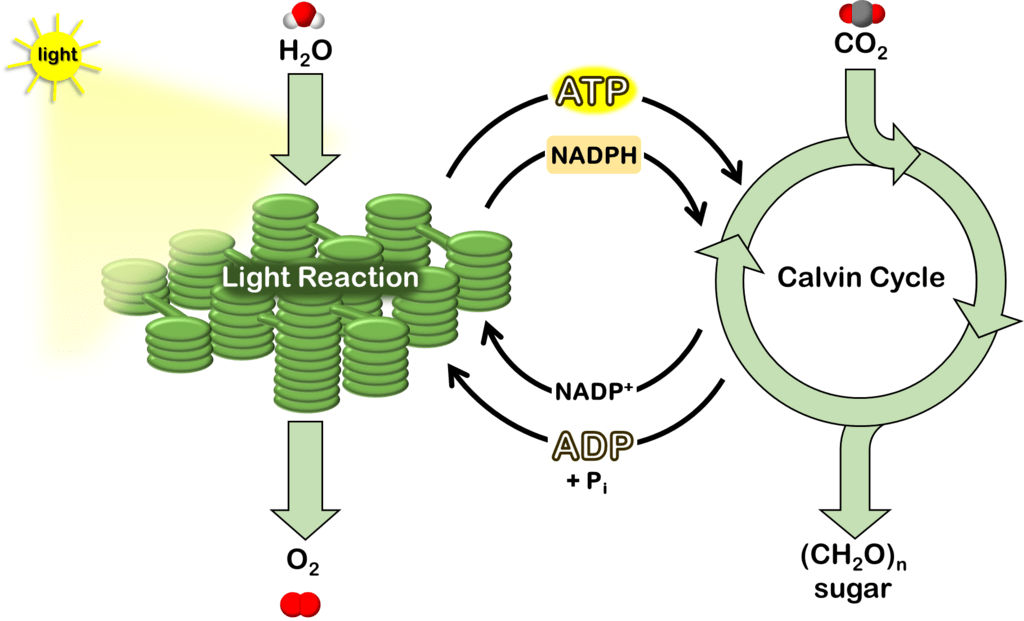
The photosynthesis equation explains how green plants use carbon dioxide and water to produce glucose and oxygen with energy from light. It summarises one of the most important biological processes on Earth and helps students understand how plants manufacture their own food. For GCSE learners, knowing the equation is essential because it connects several topics, including plant nutrition, energy transfer, gas exchange, ecosystems and the structure of specialised plant cells.
Learning the photosynthesis equation becomes much easier when each part is understood rather than simply memorised. Carbon dioxide comes from the air, water is absorbed through the roots, and light energy is captured by chlorophyll. These ingredients allow plants to manufacture glucose, which can later be used for respiration, growth and storage. Oxygen is produced during the process and much of it eventually passes from the leaves into the surrounding atmosphere.
What Is the Photosynthesis Equation?
The balanced photosynthesis equation is 6CO₂ + 6H₂O → C₆H₁₂O₆ + 6O₂, with light energy required for the process. In this formula, carbon dioxide and water are the reactants, while glucose and oxygen are the products. Chlorophyll absorbs the light energy needed to drive photosynthesis. Although the formula appears simple, it represents a complex sequence of reactions occurring mainly within chloroplasts in green plant cells.
Understanding the photosynthesis equation helps explain how plants convert light energy into chemical energy stored inside glucose molecules. Carbon dioxide enters the leaf through tiny pores called stomata, while water is transported from the roots. The plant then uses light energy to form glucose and release oxygen. This process provides plants with material for growth and supplies the starting energy source for most food chains found throughout natural ecosystems.
Photosynthesis Word Equation Explained
The word form of the photosynthesis equation is carbon dioxide + water → glucose + oxygen. Light energy and chlorophyll are required for this conversion to happen efficiently. The arrow can be read as “produces”, meaning that carbon dioxide and water are transformed into glucose and oxygen. GCSE students are often expected to know this word equation because it clearly identifies the raw materials and products without requiring detailed knowledge of chemical symbols.
A simple way to remember the photosynthesis equation is to think about what enters and leaves a plant. Carbon dioxide comes from the atmosphere, while water comes from the soil. These are used to create glucose, which the plant needs, and oxygen, which can be released into the air. Remembering this logical sequence is often more reliable than memorising individual words without understanding how they relate to the living plant.
Balanced Chemical Formula for Photosynthesis
The balanced chemical formula contains six carbon dioxide molecules and six water molecules on the reactant side. These are rearranged to produce one molecule of glucose and six oxygen molecules. The photosynthesis equation must be balanced because atoms are not created or destroyed during a chemical reaction. Instead, existing atoms are reorganised into different molecules, meaning the number of carbon, hydrogen and oxygen atoms must match on both sides.
Students should also recognise the formulas used within the photosynthesis equation. Carbon dioxide is CO₂, water is H₂O, glucose is C₆H₁₂O₆ and oxygen is O₂. The small numbers show how many atoms of each element are contained in a molecule. Understanding these symbols makes it easier to check whether an equation is balanced and reduces common GCSE mistakes, such as writing oxygen as O or incorrectly remembering the molecular formula for glucose.
Reactants and Products of Photosynthesis
Carbon dioxide and water are the main reactants involved in photosynthesis. Carbon dioxide diffuses into leaves through stomata, while water is absorbed by root hair cells before moving upwards through xylem vessels. Light is not normally described as a chemical reactant, but it provides the energy necessary for the process. Chlorophyll, located within chloroplasts, absorbs this light and allows the reactions represented by the photosynthesis equation to occur.
The main products are glucose and oxygen. Glucose is extremely valuable to a plant because it can be used during respiration, converted into starch for storage, combined into cellulose for cell walls or used to manufacture other organic substances. Oxygen is produced during photosynthesis and may diffuse out through stomata. Understanding these outputs shows why the photosynthesis equation is important not only for individual plants but also for animals and entire ecosystems.
How Photosynthesis Works in Plants
Photosynthesis occurs mainly in leaves because their cells contain large numbers of chloroplasts. Chlorophyll inside these organelles absorbs light energy, particularly from visible wavelengths that are useful for photosynthesis. Meanwhile, carbon dioxide enters from the surrounding air and water arrives from the roots. These resources are brought together through a series of chemical reactions, allowing plants to manufacture energy-rich glucose rather than obtaining food directly from another organism.
The complete process is more complex than the photosynthesis equation suggests. Photosynthesis includes light-dependent reactions and other reactions involved in building organic molecules. At GCSE level, students usually focus on the overall inputs, outputs and limiting factors rather than every biochemical stage. However, recognising that the equation is an overall summary helps explain why factors such as light intensity, carbon dioxide concentration and temperature can influence how quickly photosynthesis takes place.
Photosynthesis Equation for GCSE Biology

GCSE Biology students should be able to recall the word equation and understand the balanced chemical version. They should also know what happens to each substance involved and how plants obtain the materials required. Exam questions may ask students to complete the photosynthesis equation, identify reactants and products, interpret experimental results or explain why changing environmental conditions affects the rate at which a plant photosynthesises.
Light intensity, carbon dioxide concentration and temperature are important limiting factors. If light levels are low, increasing carbon dioxide may have little effect because light is restricting the rate. Similarly, photosynthesis depends on enzymes, so temperature can influence reaction speed. Understanding these relationships is more useful than simply memorising the photosynthesis equation because GCSE examinations often test whether students can apply their knowledge to unfamiliar experiments, graphs and practical situations.
Photosynthesis Equation vs Aerobic Respiration
Photosynthesis and aerobic respiration are closely connected but perform different functions. Photosynthesis stores energy by creating glucose, while aerobic respiration releases usable energy from glucose. During aerobic respiration, glucose reacts with oxygen to produce carbon dioxide and water while transferring energy. This can appear confusing because several substances found on one side of the photosynthesis equation appear in different positions when the aerobic respiration equation is written.
Plants carry out both photosynthesis and respiration. Photosynthesis requires light and primarily occurs in chloroplast-containing cells, whereas respiration takes place continuously in living plant cells. This means plants do not simply “photosynthesise during the day and respire at night”; respiration occurs throughout the day and night. Understanding this distinction helps GCSE students avoid mixing up the two equations and provides a clearer picture of how plants obtain, store and use energy.
Why Photosynthesis Is Important for Life
Photosynthesis forms the foundation of most food chains because it allows producers to transform light energy into stored chemical energy. Herbivores obtain this energy by eating plants, while carnivores may receive it indirectly by feeding on other animals. The photosynthesis equation therefore represents more than a plant reaction; it describes a process that helps introduce usable energy into ecosystems and supports enormous networks of organisms across terrestrial and aquatic environments.
Photosynthesis is also important for atmospheric gas cycles. Plants absorb carbon dioxide during the process and produce oxygen, helping maintain conditions that support aerobic organisms. Although global carbon and oxygen cycles involve many additional natural and human processes, photosynthesis remains a major biological component. Understanding the photosynthesis equation therefore provides students with a useful foundation for studying ecology, climate-related biology, plant growth, respiration and the movement of matter through ecosystems.
Conclusion
The photosynthesis equation provides a concise way to describe how plants use carbon dioxide and water to form glucose and oxygen using light energy. Its balanced chemical form is 6CO₂ + 6H₂O → C₆H₁₂O₆ + 6O₂. Learning what every substance represents makes the formula easier to remember and provides a much stronger understanding than simply repeating the equation without knowing how the process works.
For GCSE students, the photosynthesis equation is a core piece of biological knowledge that connects directly to plant structure, limiting factors, ecosystems and respiration. Understanding where reactants come from, how products are used and why light is necessary prepares learners for a wide range of exam questions. Once the basic equation is understood logically, more advanced ideas about plant metabolism and energy transfer become considerably easier to explore.
Frequently Asked Questions
What is the photosynthesis equation?
The balanced equation is 6CO₂ + 6H₂O → C₆H₁₂O₆ + 6O₂. It shows carbon dioxide and water being converted into glucose and oxygen using energy supplied by light.
What is the word equation for photosynthesis?
The word equation is carbon dioxide + water → glucose + oxygen. Light supplies the energy needed for the process, while chlorophyll absorbs light inside chloroplasts.
What are the reactants in photosynthesis?
Carbon dioxide and water are the main reactants. Carbon dioxide enters through stomata in leaves, while water is absorbed by the roots and transported towards photosynthesising cells.
What are the products of photosynthesis?
Glucose and oxygen are the main products. Glucose may be used for respiration, growth or storage, while much of the oxygen produced can diffuse into the surrounding atmosphere.
Why is light needed for photosynthesis?
Light provides the energy needed to drive photosynthetic reactions. Chlorophyll absorbs this energy within chloroplasts, allowing plants to transform carbon dioxide and water into energy-rich organic molecules.
You May Also Read: Emmerdale