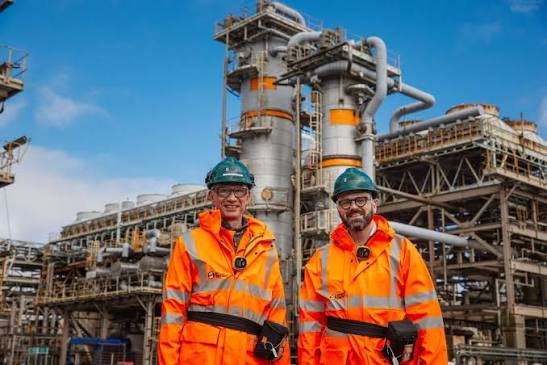
The Barrow in Furness Gas Terminal forms the onshore connection between offshore gas production in the East Irish Sea and Britain’s gas transmission network. Located on the Cumbrian coast near Barrow-in-Furness, the facilities have processed gas associated with the Morecambe area for decades. Their purpose is not simply to store gas. Offshore production reaches Barrow through pipelines, where the gas is treated so that it can meet the required specification before entering the National Transmission System.
In 2026, however, Barrow is no longer a story of conventional gas development alone. Morecambe is a mature producing area, parts of its older offshore infrastructure have already been decommissioned, and Spirit Energy is considering how the region could function after production ends. Central to that longer-term plan is Morecambe Net Zero, a proposed carbon storage development that could use depleted offshore reservoirs for captured CO₂. This combination of current production, decommissioning and possible reuse defines Barrow’s changing energy role.
What Is the Barrow in Furness Gas Terminal?
The Barrow in Furness Gas Terminal is associated with the Rampside area on the coast near Barrow-in-Furness, Cumbria. This explains why searches may refer to Barrow Gas Terminals, Rampside Gas Terminal, Spirit Energy Barrow or the Morecambe Hub. These terms can appear in discussions of the same wider energy system, although they do not necessarily describe one identical piece of infrastructure. Barrow provides the important onshore processing connection for gas arriving from offshore operations.
The gas comes from the East Irish Sea rather than the North Sea. The wider Morecambe Hub has included North Morecambe, South Morecambe and Rhyl, while current 2026 infrastructure information also includes Calder within the wider hub context. Calder has a different ownership position but is operated by Spirit Energy. Understanding these relationships matters because Barrow’s facilities are best viewed as part of a connected offshore and onshore network rather than as an independent gas plant serving only the immediate area.
How Offshore Gas Is Processed at Barrow
Understanding what happens at the Barrow in Furness Gas Terminal starts offshore. Gas produced from the Morecambe area is gathered through field infrastructure and transported toward the Cumbrian coast by pipeline. When it reaches Barrow, it is not automatically ready to enter Britain’s transmission system. Raw production can contain components that must be separated or reduced before the gas satisfies the required specification, making the onshore processing stage an essential part of the journey from reservoir to transmission network.
Current technical information for the Morecambe infrastructure describes processes including nitrogen and carbon dioxide removal, dewatering, condensate separation and methanol removal. In simple terms, these treatments condition the incoming production and separate liquids or unwanted components before suitable gas is delivered into the National Transmission System. This is a more accurate description of Barrow’s function than calling it primarily a storage facility. Its established role is fundamentally connected with receiving and treating offshore gas for onward transmission.
How Morecambe Shaped Barrow’s Gas Industry
The history of the Barrow in Furness Gas Terminal cannot be separated from the development of the Morecambe fields. Large gas discoveries in the East Irish Sea during the 1970s eventually supported decades of production. South Morecambe entered production during the 1980s, followed later by North Morecambe, while additional developments expanded the wider producing system. Barrow became the natural onshore processing location for this offshore resource and developed alongside the infrastructure required to bring Morecambe gas to market.
At its strongest point, the Morecambe Hub supplied a substantial proportion of UK domestic gas demand, with Spirit Energy putting the historical peak contribution at around one fifth. That figure describes Morecambe’s earlier importance rather than its present production level. The fields are now mature, and their role has changed as reserves have declined. This difference between historical peak production and present operations is important because it prevents the terminal’s past significance from being incorrectly presented as its current output.
Current Operations and the 2026 Position

The Barrow in Furness Gas Terminal remains connected with producing Morecambe infrastructure in 2026. Spirit Energy has continued efforts to recover remaining economically viable gas, including recent investment in well and compression work. These activities show that the Morecambe story has not yet reached a complete production shutdown. At the same time, mature fields cannot be treated as though they are beginning a new era of large-scale conventional expansion. Current activity is focused on managing remaining production responsibly and efficiently.
Spirit Energy has stated an ambition to continue Morecambe production toward the end of the decade. In April 2026, the company also announced a proposed organizational restructuring that would create a Barrow-based operating company focused on Morecambe Hub production, alongside a separate development business working on Morecambe Net Zero. Because this was presented as a proposed restructuring, it should not be confused with proof that every organizational change has already been completed. It nevertheless illustrates the increasingly distinct paths of current gas production and future carbon-storage development.
Decommissioning the Mature Morecambe Infrastructure
Decommissioning is already part of the wider Morecambe story. Offshore fields and installations do not all stop operating on the same date, so some infrastructure can be retired while other assets continue producing. Spirit Energy has previously completed decommissioning work associated with DP3 and DP4 after those installations ceased production. Their wells were plugged and abandoned before the installations were removed, providing a practical example of what happens when individual parts of a mature offshore system reach the end of their economic life.
This gradual process is important when interpreting the future of the Barrow in Furness Gas Terminal. Continuing production and decommissioning are not contradictory. Remaining infrastructure can support active fields while obsolete assets are removed or managed separately. Eventually, more facilities will reach the end of their conventional oil and gas role. Decisions about pipelines, offshore installations, wells and onshore equipment then depend on approved decommissioning requirements and whether particular assets have a technically and commercially viable purpose in future energy projects.
Morecambe Net Zero and the Proposed CCS Future
Morecambe Net Zero, or MNZ, proposes a very different use for the region’s geology. Instead of extracting natural gas, the project aims to use depleted North and South Morecambe reservoirs for permanent geological storage of captured carbon dioxide. Spirit Energy has estimated that these reservoirs could potentially accommodate around one billion tonnes of CO₂. That figure represents proposed storage potential rather than an amount already approved or stored, and further technical assessment and regulatory work remain necessary.
A significant step occurred in June 2026 when the MNZ Peak Cluster entered the Assess Phase of carbon storage licence CS010. This does not mean commercial carbon storage has begun. The assessment work contributes toward understanding the storage resource and preparing for later permitting stages. If the project progresses, captured CO₂ could eventually be transported toward the Morecambe storage system using infrastructure designed for that purpose. Potential transport concepts have included pipelines and shipping, while broader project material has also considered other logistics.
Safety, Environment and Responsible Transition
Operating the Barrow in Furness Gas Terminal involves handling hydrocarbons and industrial processing equipment, making safety management an essential part of normal operations. Local authorities provide emergency information relevant to communities around the Barrow facilities, and residents should rely on those official instructions during an actual incident. An informational article cannot replace site-specific emergency guidance because appropriate actions depend on the event and instructions issued by responsible authorities at the time.
Environmental responsibility increasingly extends beyond emissions from current operations. Mature fields require wells and infrastructure to be decommissioned safely, while any proposed carbon storage development must demonstrate that CO₂ can be contained securely over the long term. These are separate challenges. Conventional gas operations, decommissioning and future CCS each operate under their own technical and regulatory requirements. Treating them separately gives a more accurate picture than describing every environmental activity under broad terms such as sustainability or renewable-energy integration.
What Barrow’s Energy Transition Means
The future of the Barrow in Furness Gas Terminal is best understood as a transition rather than a simple closure or expansion story. Gas continues to be produced from the mature Morecambe system, but some infrastructure has already reached the decommissioning stage. Meanwhile, MNZ is being assessed as a possible future carbon storage development. Each part operates on a different timeline, and proposed CCS activity should not be described as inevitable until the necessary technical, commercial and regulatory stages have been completed.
This transition also matters because Barrow has accumulated decades of offshore, engineering and gas-processing experience. Skills associated with operating mature fields, maintaining infrastructure and managing decommissioning may remain relevant as the area’s energy activities change. Carbon storage could create another use for regional expertise if MNZ progresses, but future employment or investment should not be presented as guaranteed. The clearest 2026 picture is therefore one of an established gas region managing its remaining production while exploring what may come afterward.
Conclusion
The Barrow in Furness Gas Terminal has spent decades connecting East Irish Sea gas production with Britain’s transmission infrastructure. Its role developed around the Morecambe fields, where offshore gas was gathered and transported to Barrow for treatment before entering the National Transmission System. The Morecambe Hub was historically an important contributor to UK gas supply, but its mature fields are now at a very different stage from their peak production years.
In 2026, three developments define the site’s wider story: remaining gas production, progressive decommissioning and the proposed reuse of depleted reservoirs for carbon storage. Morecambe Net Zero has advanced into an assessment stage, but commercial CO₂ storage has not begun and still depends on further development and approvals. For readers researching Barrow today, this distinction is essential. The area remains connected with conventional gas production while simultaneously preparing for the possibility of a substantially different long-term energy role.
FAQs
What is the main purpose of the Barrow in Furness Gas Terminal?
Its established role is to receive and process offshore gas associated with the Morecambe area so suitable treated gas can enter Britain’s National Transmission System.
Where does the gas processed at Barrow come from?
The gas originates from offshore fields in the East Irish Sea. The wider Morecambe Hub has included North Morecambe, South Morecambe, Rhyl and, in current infrastructure documentation, Calder.
Is the Barrow Gas Terminal still operating in 2026?
Yes. Morecambe gas production continues, although the fields are mature and parts of the wider infrastructure have already entered or completed decommissioning.
What will happen when Morecambe gas production ends?
Further infrastructure will require appropriate decommissioning, while Spirit Energy is separately developing plans that could use depleted Morecambe reservoirs for carbon storage.
Is Morecambe Net Zero already storing carbon dioxide?
No. MNZ remains under development. Its carbon storage licence entered the Assess Phase in 2026, but commercial CO₂ storage requires additional assessment, permitting and project development before operations could begin.
You May Also Read: BSA Sloper